
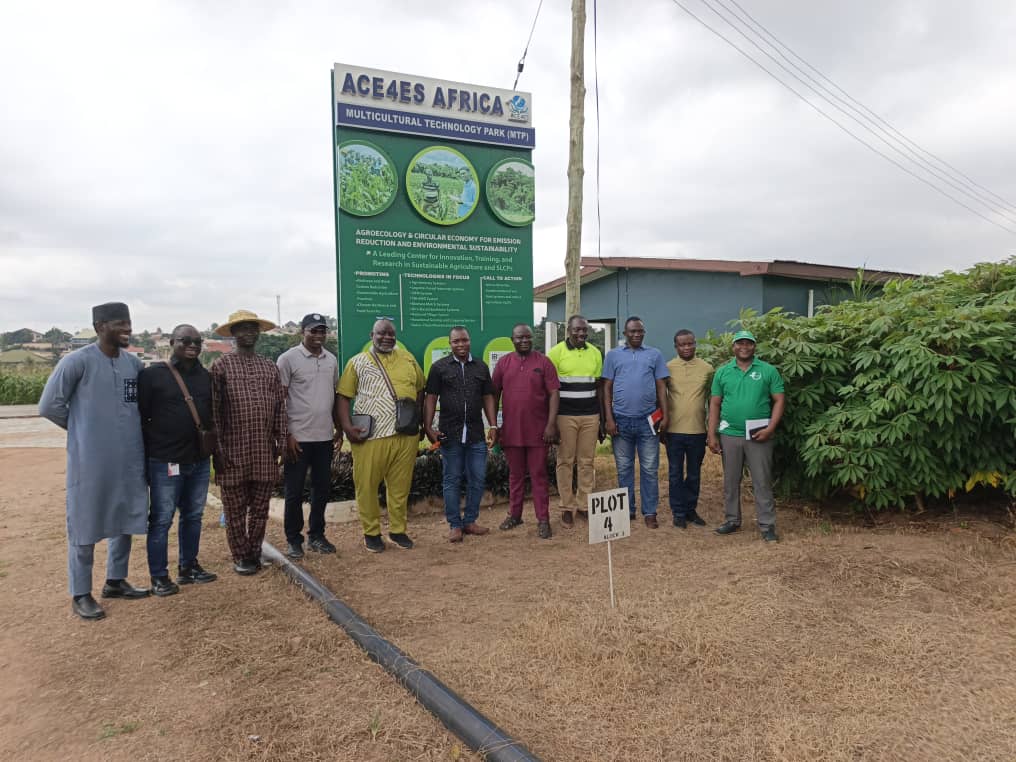
TOGO LOOKS TO GHANA’S CASSAVA SEED SYSTEM: CSIR-CRI HOSTS NINE-MEMBER PROCOMP DELEGATION FOR WEEK-LONG TECHNICAL EXCHANGE
Read more: TOGO LOOKS TO GHANA’S CASSAVA SEED SYSTEM: CSIR-CRI HOSTS NINE-MEMBER PROCOMP DELEGATION FOR WEEK-LONG TECHNICAL EXCHANGE Read more: TOGO LOOKS TO GHANA’S CASSAVA SEED SYSTEM: CSIR-CRI HOSTS NINE-MEMBER PROCOMP DELEGATION FOR WEEK-LONG TECHNICAL EXCHANGEFUMESUA, KUMASI — August 2026. The Council for Scientific and Industrial Research – Crops Research Institute (CSIR-CRI) has hosted a nine-member Togolese delegation for a week-long technical exchange mission on cassava seed systems, culminating in the transfer of foundation planting material of three CSIR-CRI-bred cassava varieties — CRI-Sika Bankye, CRI-Ampong Bankye, and CRI-Essam Bankye — for introduction into Togo.
The mission, held from 12 to 16 August 2026 at Fumesua and surrounding sites, was organised under the Programme for the Promotion of Private Sector Competitiveness (ProComp), a multi-donor initiative co-financed by the European Union and the German Federal Ministry for Economic Cooperation and Development (BMZ), and implemented by the Deutsche Gesellschaft für Internationale Zusammenarbeit (GIZ) GmbH. Cassava is one of ProComp’s priority value chains, and the exchange directly supports the programme’s target of increasing the volume of quality seeds and planting material available to Togolese producers.
A Delegation Spanning Togo’s Entire Cassava Seed Sector
The delegation was led by Dr. Tighankoumi Gmakouba, cassava breeder and lecturer at the Higher Institute of Agricultural Professions (ISMA) of the University of Kara, and an alumnus of the West Africa Centre for Crop Improvement (WACCI). He was joined by senior officials of Togo’s Directorate of Agricultural Production (DPA) — including the Heads of the Quality Control and Plant Protection Sections — the President and Vice President of the Root and Tuber Crops Interprofessional Organisation (CIFPRT), the Executive Director and Project Manager of AJA NGO, and two GIZ/ProComp Technical Advisers.
The composition was deliberate: regulators, researchers, producer organisations, civil society, and development partners travelled together, mirroring the multi-stakeholder architecture that has made Ghana’s cassava seed system a reference model for West Africa.
Inside Ghana’s Cassava Seed System
The technical programme opened with two complementary presentations that framed the week ahead. Dr. Ruth Naa Ashiokai Prempeh (PhD), Molecular Breeder in CSIR-CRI’s cassava programme, presented “Cassava Breeding, Variety Development & Seed System in Ghana” — walking the delegation through why cassava breeding matters nationally, Ghana’s market-segment-driven breeding strategy (fresh-market, processing, industrial, and future biofortified segments, each with its own target product profile), the breeding programme’s architecture and modern tools, and the variety development pipeline for both white- and yellow-fleshed cassava. She closed with the roll call of more than 30 CSIR-CRI-released varieties spanning high-dry-matter, poundable, and pro-vitamin-A carotenoid-rich types — including the very varieties now travelling to Togo — before detailing the cassava seed production cycle itself, from tissue-culture and temporary immersion bioreactor system (TIBS) plantlets through hardening and field establishment of quality seed.
Dr. Kwaku Onwona-Hwesofour Asante, Senior Research Scientist and Head of the Cassava and Related Value Chains Section, then presented “Ghana’s Cassava Research and Seed System,” deliberately picking up where the breeding talk left off. He introduced CSIR-CRI as the largest of the 13 institutes of Ghana’s Council for Scientific and Industrial Research, established in 1964 and headquartered at Fumesua — home to CORAF’s Regional Centre of Excellence for Root & Tuber Crops and a CORAF-supported Agricultural Technology Park rated top of nine such centres across West and Central Africa. He set out Ghana’s cassava seed system as a four-stage flow — breeder seed produced by CSIR-CRI, foundation seed multiplied with partners, certified and quality-declared seed multiplied by seed entrepreneurs, and adoption and feedback from farmers — underpinned by clean-seed practices, virus-indexed source blocks, and field inspection and certification by Ghana’s Plant Protection and Regulatory Services Directorate.
Dr. Asante’s presentation then broadened the lens across the full value chain: agronomy research on planting density, weed and soil-fertility management, and multi-locational variety-by-management trials; physiology work on drought response and post-harvest physiological deterioration, including an emerging electrical resistivity tomography trial with the British Geological Survey (UKRI–STFC) to image root-zone soil-water dynamics; circular economy and agroecology innovations converting cassava peels and processing residues into feed, compost, biochar, and char briquettes under the ACE4ES programme; the CARI (Cassava Anthracnose Risk Index) early-warning system, a UKRI-funded partnership with ScareCrow Intelligence (UK) and IA Sense (Brazil) that found disease risk to be stage-specific rather than calendar-driven; and post-harvest processing and value-chain work spanning gari, high-quality cassava flour, and starch. He closed by naming concrete Ghana–Togo collaboration opportunities: clean-seed production and certification training, extending CARI-type disease surveillance to Togo, circular-economy pilots, staff exchanges and co-supervised research, and joint proposals under CORAF, EU, CCAC, and UKRI funding windows.
From Research Station to Farmer Field
Field days took the delegation to planting material multiplication sites at Fumesua, where they observed multiplication practices, field inspection protocols, quality assurance, and the traceability systems that underpin certification of vegetatively propagated material.
At Offinso, the delegation visited farmer fields to see improved varieties and recommended agronomic practices performing under real production conditions. Back at Fumesua, they engaged with private-sector-supported outgrower schemes — a working demonstration of the commercial models, distribution channels, and research–industry partnerships that keep certified planting material flowing to producers. Discussions with multipliers and private actors focused on business models, commercialisation, and the sustainability of cassava seed enterprises, with participants documenting operational models adaptable to the Togolese context.
Three Varieties Cross the Border
A defining milestone of the mission was the completion of technical and phytosanitary arrangements for the transfer of foundation planting material of CRI-Sika Bankye, CRI-Ampong Bankye, and CRI-Essam Bankye to Togo. The first two varieties have recently been registered in Togo’s National Catalogue of Plant Species and Varieties, opening the way for multiplication programmes, certified seed production, and progressive dissemination to Togolese cassava producers.
The transfer was conducted in full compliance with national phytosanitary regulations and the standards governing quality control and certification of vegetatively propagated planting material — itself a practical lesson in the cross-border movement of clean planting material that the delegation will carry home.
Looking Ahead
The mission closed with a capitalisation workshop at which the delegation consolidated lessons learned, documented best practices, and identified follow-up actions for strengthening Togo’s cassava seed system, including opportunities for continued collaboration between Togolese institutions and CSIR-CRI.
The exchange reinforces CSIR-CRI’s standing as a regional hub for cassava research and seed system development, and adds a new chapter to the growing Ghana–Togo partnership on roots and tubers — one in which Ghanaian science is now literally taking root in Togolese soil.
“A seed system is more than a breeding programme. What we shared with our Togolese colleagues is the full chain — from the breeder’s plot through certified multiplication, climate-smart production, and the private-sector partnerships that carry quality planting material to the farmer. The introduction of Sika Bankye, Ampong Bankye, and Essam Bankye into Togo is a proud moment for CSIR-CRI and for West African scientific cooperation.”
— Dr. Kwaku Onwona-Hwesofour Asante, Head, Cassava and Related Value Chains Section, CSIR-CRI
“Ghana’s cassava seed system shows what is possible when research, regulation, and the private sector pull in the same direction. We return to Togo not only with foundation planting material of three improved varieties, but with a working model to adapt.”
— Dr. Tighankoumi Gmakouba, Cassava Breeder, ISMA/University of Kara, on behalf of the ProComp Team
“Breeding a variety is only the first step. Sharing our target product profiles, our variety pipeline, and the seed production cycle with our Togolese colleagues means they leave not just with planting material, but with an understanding of the science and the process behind it.”
— Dr. Ruth Naa Ashiokai Prempeh, Molecular Breeder (Cassava Breeder), CSIR-CRI
About CSIR-CRI
The CSIR-Crops Research Institute, headquartered at Fumesua, Kumasi, is Ghana’s premier institute for food and industrial crops research, with a mandate spanning variety development, seed systems, agronomy, and value chain development.
About ProComp
The Programme for the Promotion of Private Sector Competitiveness (ProComp) is co-financed by the European Union and BMZ and implemented by GIZ, running from April 2024 to March 2027. Under its Component 1, ProComp strengthens access to agricultural inputs, including quality planting material for the cassava value chain in Togo.
Media enquiries: cridirector@cropsresearch.org
