
Rooted in Water, Growing with Innovation: The Rice Story at Weta, Ghana
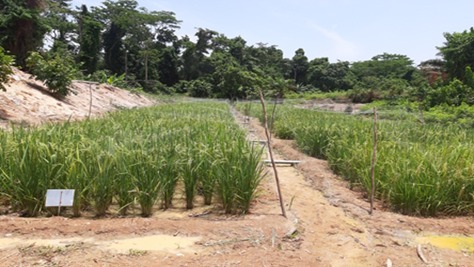
In Ghana, rice has long been associated with flooded fields. For decades, standing water has been the measure of a well-managed crop. But what if all that water isn’t necessary? At the Weta Irrigation Scheme, a quiet change is underway. Farmers are discovering that with smarter water management, rice can grow just as well, or even better, while using far less water. Through a combination of research, training, and innovative practices, the Alternate Wetting and Drying (AWD) technology is proving that tradition doesn’t always dictate practice and that small changes in irrigation can yield big results.
Breaking the Flooding Tradition
In our initial engagement with farmers at the Weta Irrigation Scheme, it quickly became clear how deeply rooted the tradition of flooded fields was. Many farmers expressed genuine concern about letting the water recede. One said, “Rice must always stand in water, otherwise it will suffer.” Another reflected, “If the field dries even a little, the crop will fail.” These statements reflected generations of practice where continuous flooding was seen as the hallmark of good management and a guarantee of a healthy harvest.
Yet research and innovation were quietly challenging these assumptions. Alternate Wetting and Drying (AWD) introduced a new perspective: rice does not always need to be submerged to thrive. Allowing the water to recede between irrigations can save water, improve efficiency, and, if paired with the right varieties and practices, maintain or even increase yields. AWD is more than a technology; it’s a shift in mindset, inviting farmers to rethink how they manage water, crops, and their own expectations about what a “healthy” field should look like.
From Proof of Concept to Practical Insights
Between 2018 and 2021, the first systematic research on AWD in Ghana was conducted by the CSIR-Crops Research Institute in collaboration with Lancaster University, under the Recirculate Project funded by the UK’s Global Challenges Research Fund (GCRF). This foundational work showed that AWD could function under Ghanaian conditions and raised important questions about water productivity, crop response, and irrigation management thresholds.
Building on these findings, the GCRF AgriFood Africa Innovation Challenge, a one-year project, explored how different rice varieties respond to AWD. The partnership expanded to include the Savannah Agricultural Research Institute and the Plant Genetic Resources Research Institute, alongside CSIR-Crops Research Institute and Lancaster University. With additional support from the Friends of Lancaster University, AWD activities were extended to multiple rice-growing communities, including Weta.
Farmers at Weta were therefore not encountering AWD for the first time. Many had observed demonstration plots and understood the basic concept. However, moving from awareness to routine field practice proved more challenging. Research showed that rice varieties differed markedly in their response to AWD, while many farmers remained uncertain about irrigation scheduling and whether yields could be maintained under reduced flooding. These findings highlighted that successful adoption required more than awareness; it required practical evidence, appropriate varieties, and continued technical support.
Evidence Meets Confidence
The next step was therefore not introducing AWD but building farmers’ confidence to apply it consistently under their own field conditions. They needed convincing evidence that rice could perform well without continuous flooding or standing water, practical guidance on irrigation scheduling, and confidence in selecting varieties that respond well to AWD. They also needed to understand how complementary practices, such as organic amendments, could improve soil moisture retention and crop performance throughout the season.
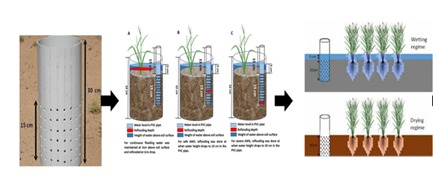
Twelve Ghanaian rice varieties were screened under controlled AWD conditions to observe how each responded to fluctuating water levels. Some varieties struggled under the drying cycles, while others adapted and thrived. Two varieties, CRI Agra and Ex-Baika, consistently performed best. Under AWD, water use dropped by over 30%, while water-use efficiency increased compared with continuous flooding. These results highlighted a key lesson: saving water does not have to mean sacrificing yield, but it does require matching the right variety with the right irrigation practice. To further strengthen farmers’ confidence, the team introduced the Automated Water Table Alert (AWATA), developed by the CSIR-Crops Research Institute. AWATA allows farmers to monitor water levels in real time, providing clear signals on when to irrigate and when the field can safely dry.
This research was conducted under the AAKTP project, which represents a strong partnership between Lancaster University, CSIR-Crops Research Institute, and New Age Agric Solutions, linking researchers, producers, and farmers. Beyond demonstrating technology, the AAKTP project also aimed to enhance the knowledge and skills of associates, preparing them for the job market while promoting the adoption of smarter irrigation practices.
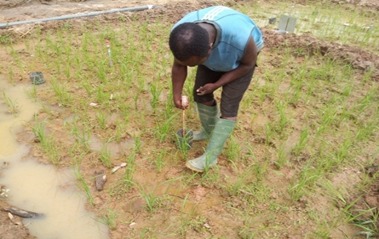
Evidence alone is not enough to change practice. AWD was implemented across five sections of the Weta scheme, accompanied by hands-on training for ten lead farmers. The training focused on practical skills: monitoring water levels using the AWATA, and adapting agronomic practices to wetting and drying cycles. At first, hesitation was natural. One farmer said, “Rice without standing water looks like it is suffering.” But as the season progressed, the results began to speak for themselves. Farmers could easily see the benefits in the field: an increased number of tillers, heavier heading of grains, larger and more sturdy tillers and panicles, darker green leaves, and robust root development. These visible, easy-to-measure agronomic improvements made the effects of AWD tangible.
Letting Go of Old Traditions, Embracing Technology and Innovation
The real proof came in adoption: eight of the ten farmers trained during the demonstration have now implemented AWD in their own fields this season, with ongoing technical support from a field-based AAKTP associate. This marks a significant shift from observation to active practice, showing that when evidence is paired with training and accessible tools, farmers are willing to change long-standing irrigation habits.
Farmers’ experiences soon told a clear story. One of these farmers shared his experience: “At first, I thought the rice would suffer without water all the time. But then I saw more tillers and panicles. My yield went up, and I didn’t have to water as much.” Another farmer laughed, “Before, we just watered on autopilot because that’s what everyone taught us. Now we water only when the rice really needs it. Sure, it means more weeding, but the extra rice makes it worth it.”
A younger farmer added, “It’s really simple once you get the hang of it. Sensors or pipes tell you when to water, no guessing needed.” Another summed it up plainly, “Now I watch my field. I don’t just flood it like before.”
One farmer jovially said, “I used to think rice was happy only in water. Now I see it likes a little dry too!” Another said with a grin, “AWD is like giving the rice a little day off, water when it wants it, not when I feel like it.” Even a farmer who had been sceptical admitted, “At first, I shook my head. But seeing my neighbours’ rice grow better than mine convinced me to try it, and I’m not going back!”
Can this Innovation Become the New Tradition?
The success of AWD quickly captured the attention of Weta Irrigation Scheme management. Mr. Daniel Dompreh Amofah, the scheme agronomist, and Mr. Bernard Mawudzro, the scheme manager, highlighted the clear benefits: higher yields and significant water savings. In response, the scheme has actively expanded demonstration plots across multiple sections, giving more farmers the chance to see AWD in action for themselves. As one operational manager put it, “When farmers see the yield and the water savings together, the argument is ended.”
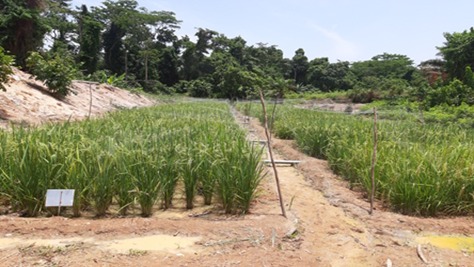
What’s different this time is that it’s the scheme itself driving the demonstrations, not AAKTP associates. Integrating AWD into the scheme’s regular operations marks a critical step toward institutional ownership and long-term adoption. Farmers can now compare traditional flooding practices with AWD side by side, building confidence and learning from each other.
At the same time, it became clear that water management alone is not enough. Soil properties, how quickly it drains, how long it retains moisture, and how efficiently nutrients are supplied during drying cycles, play a decisive role in success. This insight has shaped a new phase of trials, testing organic digestate amendments to improve soil water retention, nutrient efficiency, and yield stability under AWD.
If combining smarter irrigation with the right rice varieties has already delivered gains, integrating soil enhancement within scheme-level demonstrations could unlock even greater resilience.
The Proof Policy Needs
For policymakers, the lessons from Weta are clear. Smarter irrigation can save water while increasing yields, proof that innovation works on the ground, not just on paper. And it’s not just anecdotal: careful data collection on water use, crop performance, and field management provides the solid evidence needed to guide decisions, design interventions, and scale practices with confidence.
Scaled effectively, AWD could help irrigation schemes use water more efficiently, support double cropping, and strengthen domestic rice production without adding pressure on limited water resources. But turning this potential into reality requires coordination across research institutions, irrigation authorities, private-sector value chains, and government agencies, ensuring that evidence translates into actionable policy.
What began as a knowledge-transfer project under AAKTP has now become concrete proof that Ghanaian rice systems can adapt and thrive without compromising farmer incomes. Farmers have adopted AWD, demonstration plots are expanding, and new trials are underway. The question is no longer whether AWD works, the real challenge is how strategically and how quickly it can be scaled to strengthen national rice self-sufficiency and build resilience into the sector.
Authors
Vincent Opoku Agyeman (vincent.opoku@stu.ucc.edu.gh)
Stephen Yeboah (proyeboah@yahoo.co.uk)
Patricia-Amankwaah Yeboah (pataamankwaa@yahoo.com)
Mavis Badu Brempong (abulgo@yahoo.co.uk)
Bernard Sakyiamah (bernard.sakyiamah@gmail.com)
Ian C Dodd (i.dodd@lancaster.ac.uk)
